La religion est un homme
Titre original : Religion is a man
Quel est le sens de la religion ? Découvrez le véritable sens de la religion de Dieu, depuis le temps d’Adam jusqu’à aujourd’hui, à travers les enseignements du Riseur Aba Al-Sadiq (de Lui est la Paix).
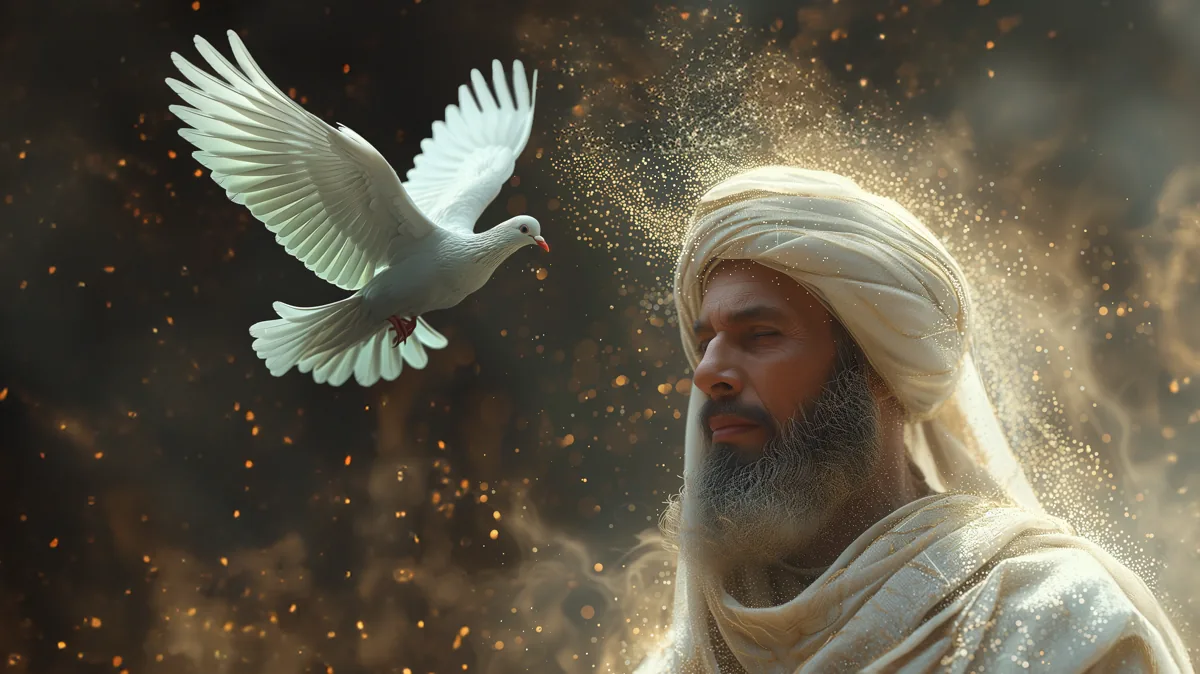
La seule religion acceptable aux yeux de Dieu est la soumission. Il est attendu des gens qu’ils soient en permanence dans un état d’obéissance et de soumission totales à Dieu, quoi qu’il arrive, dans les bons moments comme dans les mauvais, dans la maladie comme dans la santé. Mais comment nous soumettre à Dieu ? Comment cela se fait-il ?
Les humains n’ont pas de communication directe avec Dieu ; l’humanité n’a donc aucune idée de ce que Dieu attend d’elle, à moins que Dieu n’envoie quelqu’un comme messager ou comme représentant de Sa part.
« La religion est un homme. Trouver cet homme et suivre cet homme. Dans la Bible, tout au début, il est dit que Dieu marchait dans le jardin d’Éden aux côtés d’Adam et Ève, et dans le Coran il est dit qu’Allah a insufflé de Son esprit en Adam. Après avoir insufflé de Son esprit en Adam, Il a ordonné aux anges de se prosterner devant Adam. Ce que nous tirons de ce récit, c’est qu’il y a cet esprit, cette part de Dieu, l’esprit de Dieu qui a été insufflé, et il a été envoyé à l’intérieur de la création. Cet esprit de Dieu qui n’est pas né, qui ne meurt jamais et qui est éternel, demeurant dans la création. C’est Dieu dans la création. C’est cela, la religion : trouver l’esprit de Dieu et le suivre. L’esprit de Dieu est entré en Adam, puis, après la mort d’Adam (et Adam n’était qu’un voile), il est entré dans son successeur, puis dans son successeur, et dans son successeur, et dans son successeur, et dans son successeur, et il est éternel, pour toujours. L’esprit de Dieu a donc de nombreux noms et de nombreux voiles. Parmi ses voiles furent Adam, Noé, Moïse, Jonas et chacun des Prophètes d’Allah. Tous les Prophètes d’Allah constituent une part de Dieu dans la création, et Dieu dans la création est cet esprit qui est éternel, du commencement jusqu’à la fin. Le but de la religion est de trouver cet homme, ce voile derrière lequel se trouve l’esprit de Dieu, et de se prosterner. D’obéir. De lui donner la victoire. C’est cela, la religion. »
— Le Riseur Abdullah Hashem Aba Al-Sadiq (de Lui est la Paix)
Lorsque Dieu créa Adam (PSL), Il voulut que les anges et la création tout entière se prosternent devant Adam (PSL) et se soumettent à lui : c’est ainsi que Dieu voulait être adoré.
« Et lorsque Je l’aurai harmonieusement formé et que J’aurai insufflé en lui de Mon âme [créée], tombez prosternés devant lui. »
— Le Saint Coran, chapitre 15 (Al-Hijr), verset 29
Iblis (que Dieu le maudisse) refusa cependant de se prosterner, et il fut compté parmi les mécréants. Dans un hadith de l’Imam Al-Sadiq (de Lui est la Paix), l’Imam établit clairement que la prosternation devant Adam (PSL) était la seule manière dont Dieu voulait être adoré :
Le premier qui fit une comparaison et s’enorgueillit fut Iblis, et l’orgueil est le premier acte de désobéissance à Dieu. Il dit :
« Iblis dit : “Ô Dieu, dispense-moi de me prosterner devant Adam, et je T’adorerai comme ne T’a adoré aucun ange rapproché ni aucun Prophète Messager.” Dieu dit : “Je n’ai pas besoin de ton adoration ; Je veux plutôt être adoré par où Je le veux, et non par où tu le veux.” Mais il refusa encore de se prosterner, et Dieu dit : “Sors d’ici, tu es impur, et en vérité Ma malédiction est sur toi jusqu’au Jour du Jugement.” »
— Bihar Al-Anwar, Al-Allamah Al-Majlisi, vol. 11, p. 141
La prosternation et la soumission à l’esprit de Dieu, en chaque jour et en chaque époque : voilà la religion. Vous pouvez mourir en soi-disant musulman, croyant en la prophétie du Prophète Mohammed (PSL et sa famille) ; mais si vous rejetez ses successeurs, vous ne serez pas compté parmi les croyants.
Le Prophète Mohammed (PSL et sa famille) a dit :
« Quiconque meurt sans prêter allégeance à l’Imam de son temps est mort de la mort de l’ignorance. »
— Al-Aql wa Al-Jahl fi Al-Kitab wa Al-Sunnah, Mohammed Al-Reyshahri, p. 275
Traduction alignée sur celle de l’enseignement « La religion est un homme ».
Cela signifie que le Prophète Mohammed (PSL et sa famille) n’était pas le dernier guide de l’humanité : Dieu ne romprait jamais Son lien avec la création à travers un homme après avoir établi que Sa religion passe par un homme. C’est pourquoi le verset du Coran est descendu, le pressant de révéler son successeur, faute de quoi ce serait comme s’il n’avait rien fait.
« Ô Messager, annonce ce qui t’a été révélé de ton Seigneur ; et si tu ne le fais pas, alors tu n’as pas transmis Son message. Et Allah te protégera des gens. En vérité, Allah ne guide pas les gens mécréants. »
— Le Saint Coran, chapitre 5 (Al-Ma’idah), verset 67
Traduction alignée sur celle de l’enseignement « La désignation d’Ali ibn Abi Talib à Ghadir Khum ».
C’est à ce moment que le Prophète Mohammed (PSL et sa famille), le jour de Ghadir Khum, prit la main de l’Imam Ali (de Lui est la Paix) en disant :
« Celui dont je suis le Maître, Ali est son Maître. »
— Mizan Al-Hikmah (La Balance de la sagesse), Mohammed Al-Reyshahri, vol. 1, p. 138
Et la désignation de cet homme, l’Imam Ali (de Lui est la Paix), marqua le parachèvement de la religion :
« Aujourd’hui, J’ai parachevé pour vous votre religion, J’ai accompli sur vous Mon bienfait, et J’ai agréé pour vous l’islam comme religion. »
— Le Saint Coran, chapitre 5 (Al-Ma’idah), verset 3
La nuit de sa mort, le Prophète Mohammed (PSL et sa famille) réaffirma la succession de l’Imam Ali (de Lui est la Paix) et énuméra les successeurs qui viendraient après lui : des guides infaillibles qui indiqueraient le droit chemin en chaque jour et en chaque époque.
« Le Prophète Mohammed (PSL et sa famille) a dit à Ali (PSL) la nuit de sa mort : “Ô Père d’Al-Hassan, apporte-moi une plume et du papier”, et le Messager d’Allah (PSL et sa famille) dicta son Testament jusqu’à parvenir à ce passage où il dit : “Ô Ali, il y aura douze Imams après moi, et après eux il y aura douze Mahdis. Ainsi toi, ô Ali, tu es le premier des douze Imams. Allah l’Exalté t’a nommé dans Ses cieux Ali Al-Murtada (le Satisfait), Amirul Mo’mineen (le Prince des Croyants), Al-Siddiq Al-Akbar (le Plus Grand Véridique), Al-Farouq Al-A’tham (le Plus Grand Juge et Différenciateur entre la vérité et le mensonge), Al-Ma’moun (le Digne de confiance) et le Mahdi (le Guidé). Ces noms ne peuvent être attribués à nul autre que toi. Ô Ali, tu es mon vice-gérant/gardien sur ma propre famille, sur leurs vivants et leurs morts, et sur mes femmes : celle que tu auras gardée me retrouvera demain, et celle que tu auras répudiée, j’en suis innocent, je ne la verrai pas et elle ne me verra pas au Jour de la Résurrection. Et tu es mon successeur (Khalifa) sur ma nation après moi. Si la mort vient à toi, remets-le à mon fils Al-Hassan, le juste et le bienveillant. Puis si la mort vient à lui, qu’il le remette à mon fils Al-Hussein, le martyr, le pur et l’assassiné. Si la mort vient à lui, qu’il le remette à son fils, le maître des adorateurs, Dhul Thafanat (celui qui a la peau dure aux genoux) Ali. Si la mort vient à lui, qu’il le remette à son fils, Mohammed Al-Baqir (le Révélateur de la Connaissance). Si la mort vient à lui, qu’il le remette à son fils, Ja’far Al-Sadiq (le Véridique). Si la mort vient à lui, qu’il le remette à son fils, Musa Al-Kathim (le Patient). Si la mort vient à lui, qu’il le remette à son fils, Ali Al-Ridha (l’Agréable). Si la mort vient à lui, qu’il le remette à son fils, Mohammed Al-Thiqa Al-Taqqi (le Digne de confiance, le Craignant Dieu). Si la mort vient à lui, qu’il le remette à son fils, Ali Al-Nasih (le Conseiller). Si la mort vient à lui, qu’il le remette à son fils, Al-Hassan Al-Fadhil (le Méritoire). Si la mort vient à lui, qu’il le remette à son fils, Mohammed le Protégé de la Famille de Mohammed (PSE). Tels sont les douze Imams. Puis il y aura douze Mahdis après lui ; si la mort vient à lui, qu’il le remette à son fils, le premier des proches, il a trois noms, l’un comme le mien et celui de mon Père, et c’est Abdullah (Serviteur de Dieu), Ahmed (le Loué), et le troisième nom est Al-Mahdi (le Guidé), et il est le premier des croyants.” »
— Ghaybat Al-Toosi, vol. 1, p. 174
— Bihar Al-Anwar, Al-Allamah Al-Majlisi, vol. 53, p. 148
Traduction alignée sur celle de l’enseignement « Le Saint Testament (narration) ».
Aujourd’hui, celui qui abrite l’Esprit de Dieu, et celui à qui l’on doit obéir sans négocier, est le Mahdi mentionné dans le Testament du Prophète Mohammed (PSL et sa famille), l’« Abdullah » mentionné dans le Testament, et cet homme est Abdullah Hashem Aba Al-Sadiq (de Lui est la Paix).
Texte original (anglais)
Religion is a man
[Image]
The only religion that is acceptable to God is submission. The people are expected to be in a constant state of complete obedience and submission to God no matter what, in good times and in bad times, in sickness and in health. But how do we submit ourselves to God? How is that done?
Humans do not have a direct communication with God, so mankind has no idea what God wants from them, unless God sends someone as a messenger or as a representative from himself.
“Religion is a man. Finding that man and following that man. In the Bible, in the very beginning, it says that God was walking in the garden of Eden alongside Adam and Eve, and in the Quran it says that Allah blew from His spirit into Adam. After he blew from His spirit into Adam, he commanded the angels to prostrate down to Adam. What we get from this story is that there is this spirit, this part of God, the spirit of God that was blown, and it was sent inside creation. That spirit of God which was not born, nor does it ever die, and is everlasting, remaining in creation. That is God in creation. That is religion. To find the spirit of God and to follow it. The spirit of God went inside Adam, and then after Adam passed away (and Adam was just a veil), it went into his successor, and then his successor, and his successor, and his successor, and his successor, and is everlasting forever. So the spirit of God has many names and many veils. From his veils were Adam, Noah, Moses, Jonah and every single Prophet of Allah. All of the Prophets of Allah, they make up a part of God in creation, and God in creation is that spirit which is everlasting, from the beginning all the way to the end. The goal of religion is to find that man, that veil behind which the spirit of God is, and to prostrate. To obey. To give victory to him. That is religion.” - The Riser Abdullah Hashem Aba Al-Sadiq (From Him is Peace)
When God created Adam (PBUH), he wanted that the angels and creation as a whole prostrate and submit themselves to Adam (PBUH), that is how God wanted to be worshiped.
“And when I have proportioned him and breathed into him of My [created] soul, then fall down to him in prostration." - The Holy Qur’an, Chapter 15 (Al-Hijr), Verse 29
Iblis (May God curse him) however refused to prostrate and was counted amongst the disbelievers in a Hadith by Imam Al-Sadiq (From Him is Peace) the Imam makes it clear that the prostration of Adam (PBUH) was the only way God wanted to be worshipped: The first one who compared and was prideful was Iblis, and pride is the first act of disobedience to God. He said:
“Iblis said: ‘O God, pardon me from prostrating to Adam and I shall worship You like no other close angel nor Prophet Messenger has.’ God said: ‘I do not need your worship, but rather I want to be worshiped from where I want and not from where you want.’ But he still refused to prostrate, so God said: ‘Get out of it, you are impure, and verily upon you is My curse until the Day of Judgment.’” - Bihar Al-Anwar, Al-Allamah Al-Majlisi, Vol. 11, p. 141
Prostration and submission to the spirit of God in every day and age is religion. You can die as a so-called Muslim believing in the Prophethood of Prophet Mohammed (PBUH & His Family) but if you reject his successors you will not be counted amongst the believers. Prophet Mohammed (PBUH & His Family) said:
“Whoever dies and doesn’t pledge allegiance to the Imam of his time has died the death of ignorance.” - Al-Aql wa Al-Jahl fi Al-Kitab wa Al-Sunnah, Mohammed Al-Reyshahri, p. 275
This means that Prophet Mohammed (PBUH & His Family) was not the last guide for mankind, God would never cut his ties with creation through a man after he has established that his religion is through a man. That is why the verse from the Qur’an came down insisting him to reveal his successor otherwise it would be as if he had done nothing.
“O Messenger, announce that which has been revealed to you from your Lord, and if you do not, then you have not conveyed His message. And Allah will protect you from the people. Indeed, Allah does not guide the disbelieving people.” - The Holy Qur’an, Chapter 5 (Al-Ma’idah), Verse 67
It was at that moment that Prophet Mohammed (PBUH & His Family) on the day of Ghadir Khum took the hand of Imam Ali (From Him is Peace) saying:
“Whoever I am the Master of, Ali is his Master.” - Mizan Al-Hikmah (Scale of Wisdom), Mohammed Al-Reyshahri, Vol. 1, p. 138
And the appointment of this man, Imam Ali (From Him is Peace) marked the perfection of the religion:
“This day I have perfected for you your religion and completed My favor upon you and have approved for you Islām as religion.” - The Holy Qur’an, Chapter 5 (Al-Ma’idah), Verse 3
On the night of his death, Prophet Mohammed (PBUH & His Family) reaffirmed his successorship to Imam Ali (From Him is Peace) and listed the successors that would follow after him, infallible guides that would point to the right path in every day and age.
“Prophet Mohammed (PBUH & His Family) said to Ali (PBUH) on the night of his death, ‘O Father of Al-Hassan, bring me a pen and a paper,’ so the Messenger of Allah (PBUH & His Family) dictated his Will until he came to this position where he said: ‘O Ali, there will be twelve Imams after me and after them there will be twelve Mahdis. So you, O Ali, are the first of the twelve Imams, Allah the Exalted has named you in His heavens Ali Al-Murtada (the Content), Amirul Mo’mineen (the Prince of the Believers), Al-Siddiq Al-Akbar (the Greater Truthful), Al-Farouq Al-A’tham (the Greater Judge and Differentiator between truth and falsehood), Al-Ma’moun (the Trusted), and the Mahdi (the Guided). These names may not be attributed to other than you. O Ali, you are my vicegerent/guardian over my own family, their living and their dead, and upon my women: Whomever you kept, she shall find me tomorrow, and whomever you divorced, I am innocent of her, I will not see her and she will not see me on the Day of Resurrection. And you are my successor (Khalifa) over my nation after me. If death comes to you, hand it over to my son Al-Hassan, the righteous and benevolent. Then if death comes to him, let him hand it over to my son Al-Hussein, the martyr, the pure and murdered. If death comes to him, let him hand it over to his son, the master of worshipers, Dhul Thafanat (the one with hard skin on his knees) Ali. If death comes to him, let him hand it over to his son, Mohammed Al-Baqir (the Revealer of Knowledge). If death comes to him, let him hand it over to his son, Ja’far Al-Sadiq (the Truthful). If death comes to him, let him hand it over to his son, Musa Al-Kathim (the Patient). If death comes to him, let him hand it over to his son, Ali Al-Ridha (the Pleasing One). If death comes to him, let him hand it over to his son, Mohammed Al-Thiqa Al-Taqqi (the Trustworthy, the God-Fearing). If death comes to him, let him hand it over to his son, Ali Al-Nasih (the Advisor). If death comes to him, let him hand it over to his son, Al-Hassan Al-Fadhil (the Meritorious). If death comes to him, let him hand it over to his son, Mohammed the Safeguarded of the Family of Mohammed (PBUT). Those are the twelve Imams. Then there will be twelve Mahdis after him, so if death comes to him, let him hand it over to his son, the first of the close ones, he has three names, one like mine and my Father’s and it is Abdullah (Servant of God), Ahmed (the Praised), and the third name is Al-Mahdi (the Guided), and he is the first of the believers.’ ” - Ghaybat Al-Toosi, Vol. 1, p. 174; Bihar Al-Anwar, Al-Allamah Al-Majlisi, Vol. 53, p. 148
Today, the one who houses the Spirit of God and the one who must be obeyed without negotiating is the Mahdi mentioned in the Will of Prophet Mohammed (PBUH & His Family), the “Abdullah” mentioned in the Will, and that man is Abdullah Hashem Aba Al-Sadiq (From Him is Peace).
Source
Religion is a man - The Ahmadi Religion of Peace and Light — theahmadireligion.org/blog/religion-is-a-man/ (nouvel onglet)
Publié le 10 janvier 2024, mis à jour le 30 août 2026 ; texte relevé le 16 octobre 2026. Traduction intégrale de l’anglais par la rédaction.