UK: The file against AROPL in Crewe remains empty: more intelligence said to be needed…
Read aloud in English
Read the original article on Atheist Times
A Chester court extends restrictive orders against seven AROPL members for another six months. An eyewitness account of the hearing
By Human Rights Without Frontiers
UNITED KINGDOM: The file against AROPL in Crewe remains empty: police investigator says more intelligence is needed…
A Chester court extends restrictive orders against seven AROPL members for another six months. An eyewitness account of the hearing
By Hans Noot, Associate Director, Human Rights Without Frontiers
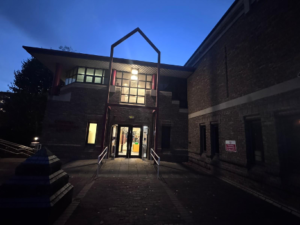
HRWF (28.10.2026) – On 22 October 2026, I sat in Chester Magistrates’ Court for a full day. I was one of four international observers following the case of the Ahmadi Religion of Peace and Light (AROPL). Cheshire Police had asked the court to extend the interim Slavery and Trafficking Risk Orders (STRO) against seven members of the religious community for another six months. The police said they needed the time to gather more evidence. The investigation began with the raid on Webb House in Crewe on 29 April 2026.
Almost six months after more than 500 officers entered the community’s headquarters, no one faces any charge connected with the allegations that justified the raid. As far as the public knows, no drugs and no firearms were found, and there was no sign of security issue towards society or the state. What the officers did find on 29 April was a group of shocked believers.
The court nevertheless gave the police what they asked for.
An open court, but not for everyone
The four of us came from two continents. Dr Susan Palmer, a sociologist of religion from Canada, has written extensively on state raids against minority religions in the world. Marco Respinti, director-in-charge of Bitter Winter, came from Italy. Heshmat Ali, a California-based lawyer who advises AROPL, came from the United States, and I came from the Netherlands on behalf of HRWF.
We left our B&B in Crewe early and were through security at Grosvenor Street by 8:55 am. The hearing was listed for 10:00. The courtroom doors opened more than half an hour late, and nobody explained why.
Just before the start, we were told that only three seats were available for us and that we had to choose which of us would stay outside. After we appealed, the judge kindly allowed a fourth chair. When we walked in, however, six or seven protesters were already seated. They have campaigned against AROPL for months since the raid, and some of them have harassed its members, including me personally when I was there in July. In September, the Chester Standard reported a scuffle among protesters at the doors of this same court, as well as attempts to film inside the building, which is a criminal offence.
I do not question the right of any member of the public to attend an open hearing. I do question why people with a record of hostility towards the respondents found seats waiting for them, while independent foreign observers had to plead for a chair.
What the court was asked to decide
A STRO is a civil order, not a criminal conviction. Under section 23 of the Modern Slavery Act 2015, a magistrates’ court may make a STRO only if it is satisfied that the person has acted in a manner indicating a risk of committing a slavery or human trafficking offence. The court must also be satisfied that the order is “necessary” to protect others from harm. The orders against the AROPL members, however, are interim orders, which apply while the court has not yet ruled on the full application. Under section 28, the court may grant an interim order simply “if it considers it just to do so”, and only “for a fixed period”.
The first interim orders were granted on 1 May, two days after the raid, against AROPL’s leader Abdullah Hashem and four other members (BBC). Since then, the people named have been barred from entering Crewe, where their homes, families and place of worship are.
The police barrister presented the application narrowly. In her view, the hearing concerned only the renewal of the interim orders, not the details of the case. The court did not need to rule on the credibility of the evidence, she said, only on whether the alleged conduct might be repeated.
The defence put the legal test back at the centre: proportionality, and whether more time had any realistic chance of producing evidence. After six months, they asked in essence, what has been found, and what would another six months add?
What I can and cannot report
For most of the day, two defence lawyers questioned the detective inspector who leads the investigation and who had sought the raid on Webb House.
At the end of the hearing, the court imposed a temporary order restricting reporting on the evidence heard that day and on naming third parties, including witnesses.
HRWF will respect that order. Readers will therefore not find the details of the questioning here.
What I can say is what anyone in the room could see. The defence repeatedly asked whether a single allegation by the sole complainant had been independently corroborated. Cheshire Police have said publicly from the start that the allegations concern one woman (BBC). The answer I heard most often was a variation of “this is an ongoing investigation.” That was often followed by “we have more intelligence that we cannot talk about, but it needs to be worked out,” or “some of it cannot be disclosed.”
To me, as an observer, it sounded less like a case being built than a case still looking for its foundation.
The ruling
The hearing ran until about 5:00 pm, with a one-hour lunch break. The judge then retired to his chambers and returned around half an hour later. He acknowledged that much of the police material was based on hearsay. Even so, given the seriousness of the alleged offences, he extended the orders by six months, to 30 April 2027!
The restrictions therefore stay in place. The respondents are still presumed innocent but remain on bail, may not enter Crewe and, under their current conditions, remain separated from their children.
Dr Palmer told me afterwards that she had been “flabbergasted.” In her view, the AROPL lawyers had made very strong arguments, and she could not see why the judge granted the extension after acknowledging that most of the police evidence was hearsay. I share her surprise.
Why this matters
By the end of the extension, these men and women will have lived for a full year under restrictions normally associated with dangerous offenders, despite their presumption of innocence.
They have not been charged with any crime, let alone convicted.
They are kept from their homes, their children and their place of worship on the strength of allegations which, by the police’s own account, they still need time to substantiate.
The case is already showing cracks. On 15 October, police told the lawyer of Ivan Morales, one of the suspects, that no further action would be taken against him. Morales had not even been in the United Kingdom at the time of the alleged offence. In September, the cases against 14 Webb House residents charged with obstructing police during the raid were discontinued (BBC).
Cheshire Police have repeatedly stated that they are “not investigating the religion” (BBC). That is welcome. However, the effects of these orders fall on a whole religious community, whose leadership has been removed from its centre for half a year and now faces another six months away.
The presumption of innocence (Article 6(2) of the European Convention on Human Rights), the right to family life (Article 8) and freedom of religion (Article 9) do not disappear because an allegation is serious. If anything, the more serious the allegation, the more carefully courts should check that restrictions are based on evidence rather than on hope that evidence will turn up. A civil order with a lower threshold should not become an open-ended substitute for a criminal case the police cannot yet make.
There is also a question of open justice. The hearing was public, yet the court has temporarily restricted reporting on the evidence. HRWF respects that order, and the law allows such restrictions to protect proceedings. But its practical effect deserves attention.
The police remain free to describe the allegations as “serious” in public statements, and hostile campaigners continue to spread their version online. Meanwhile the scrutiny those allegations received in open court cannot be reported. Freedom of expression includes the public’s right to receive full information. When only one side of a public hearing can be heard outside the courtroom, the presumption of innocence is the first casualty.
I left Chester with one question. If the file is still this thin after six months, what is the court’s answer if it is still thin in April 2027?
HRWF will continue to monitor the case.